Anrealage FW24 / Fall Winter 2024 – 2025 at Paris Fashion Week
In a fashion world obsessed with the impossible conundrum of fit, where humans of all shapes and sizes spend their lives adapting to clothing, Kunihiko Morinaga for the Anrealage Fall Winter 2024 – 2025 season pays tribute to inanimate objects.
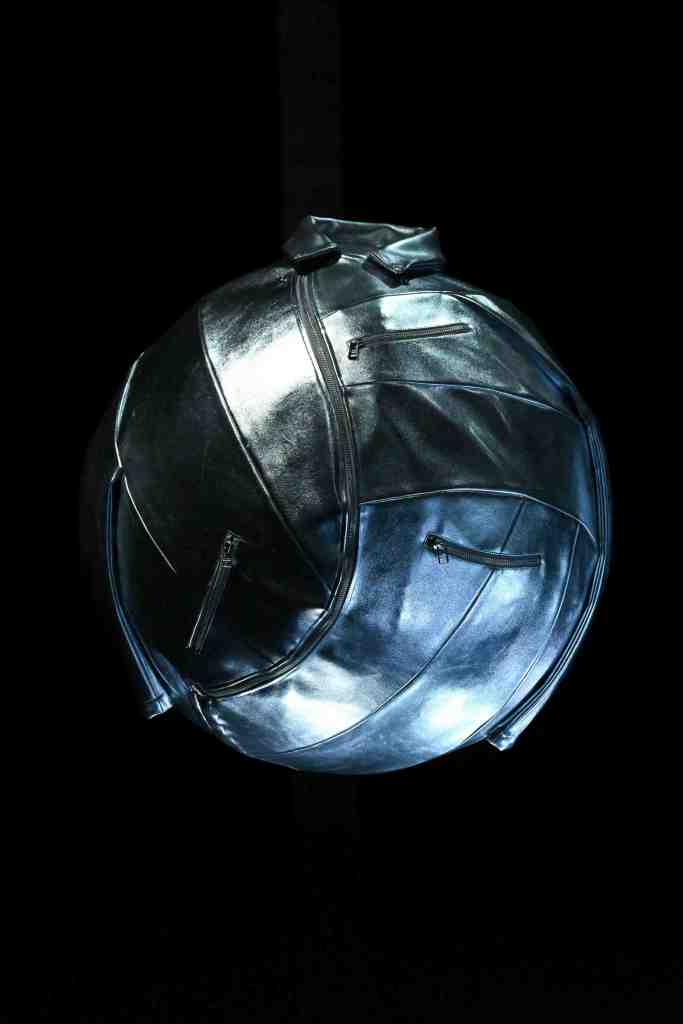
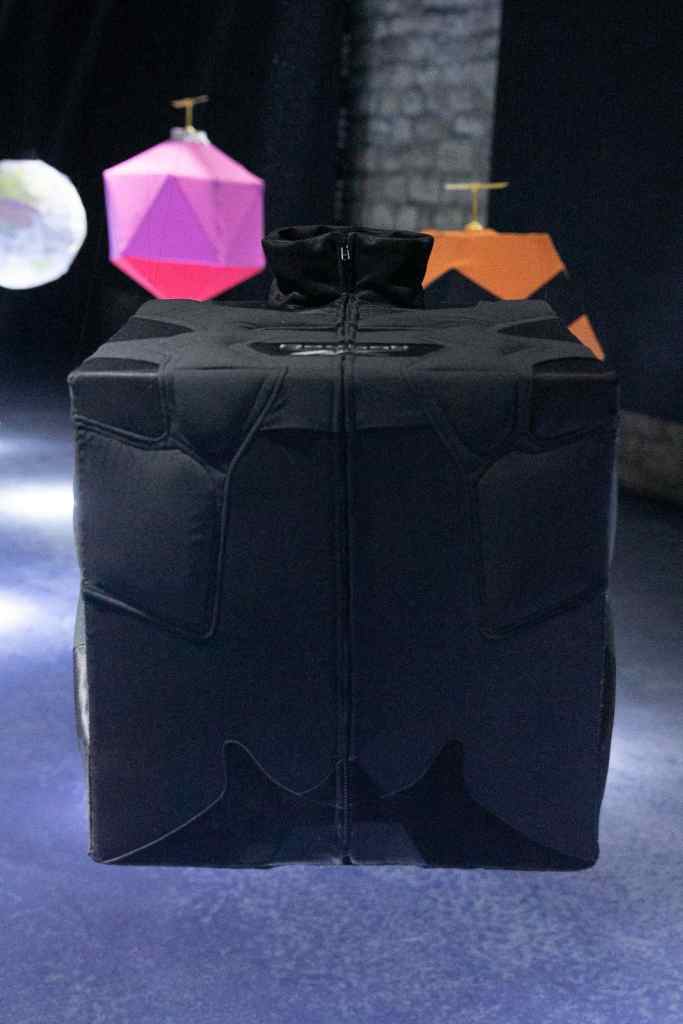
In a darkened space under the Pont Alexandre III, an enchanting yet alien scene unfolds, as a succession of geometrical shapes – including spheres, pyramids, cubes, octahedrons, dodecahedrons and icosahedrons – floats down the runway outfitted in graphic contemporary looks, twirling and pausing to pose for the cameras.
The opening look – a sphere clad in a blue and white ball shirt and propelled by a Take-copter, like some sort of kawaii drone – evokes Doraemon, the time-traveling, gadget-loving, earless cat-robot from the popular eponymous 1970s Japanese chil-children’s cartoon series. Kunihiko Morinaga pays tribute to one of his childhood heroes, Fujiko F. Fujio, the series’ co-creator and the inventor of a genre echoing Anrealage’s whimsical design universe: ‘Sukoshi Fushigi,’ a kind and warm-hearted spin on sci-fi where the real and the unreal, the ordinary and the extraordinary, happily co-exist in not-so-distant parallel worlds.
Doraemon is followed by other main characters from the series including Dorami, Nobita, Suneo, Gian and Shizuka, respectively depicted as a pyramid, cube, octahedron and dodecahedrons, and enveloped in recomposed versions of their signature uniforms in graphic color blocks, Anrealage FW24.
On their tail comes a series of spherical creations including a look teasing Kunihiko Morinaga’s soon-to-launch debut collection for HERNO® Globe, the sustainable line of Italian luxury brand HERNO, as the label’s new creative director, as well as a globe blouson featuring a design produced by FOREARTH, a revolutionary water-free concept inkjet printing process developed by Kyocera Corporation. Elsewhere, shapes in sporty quilted down looks revisit Reebok’s Instapump Fury 94 sneaker.
Nine of designs icluding a metallic mirror ball-inspired biker jacket and boldly striped glow-in- the-dark looksare transplanted onto real human models who pair with their object avatars, with the clothes adopting dramatic drapes, asymmetric volumes and generous and elaborate cocoon shapes as gravity takes hold.
Rejecting the “nonsensical and violent” reality of the traditional way of making clothes, and the illusion of “clothes that look good on everyone,” Kunihiko Morinaga, by designing clothes as objects as well as clothes for objects, offers a playful new take on the one-size-fits-all ethos.
When adopted by the human form, regardless of age, gender or size, clothes designed for objects, in all their apparent simplicity, take on an unexpected beauty, sketching the blueprint for a fantasy everyday wardrobe 100 years from now.
DORAEMON is a SF, Science Fiction / Sukoshi Fushigi (slightly unusual) manga series created by FUJIKO・F・FUJIO for children.
The Doraemon comic series was published since 1970 and has sold more than 290 million copies worldwide; its animated counterpart has been broadcast in over 70 countries on major networks.
Doraemon is a robot cat from the 22nd century who uses his secret gadgets to help Nobita, a boy who is always getting into sticky situations.
He pulls his secret gadgets like “Hopter” and “Anywhere Door” out of his 4D Pocket to enable Nobita and his friends, Shizuka, Gian, and Suneo, to fulfill their wildest dreams and take them on unlimited adventures.
This robotic cat from the future remains one of the most beloved characters across the globe even today.
A pioneer in sustainable textile printing, the company developed a new inkjet textile printer named “FOREARTH” which provides solutions for sustainability challenges in the fashion industry, such as water pollution during printing and the mass destruction of fashion and textile overstock.
FOREARTH does not use any water during the printing process, with only a small amount of water required for maintaining the machine. When using traditional printing methods, 153L*1 water per 1kg textile is needed, compared to only 0.02L*2 water per 1kg with FOREARTH. *1 Kujanpää , M. & Nors , M. (2014). Environmental performance of future digital textile printing. VTT Technical Research Centre of Finland.VTT Customer Report Vol. VTT CR 04462 14 *2 Based on Kyocera research, in 2022






All images Anrealage FW24 by Anrealage
Photographer KOJI HIRANO
PR Agency PR Consulting Paris