Iris Van Herpen Fall/Winter 2026-2027 / FW26 at Paris Couture Week entitled ‘Sonic Starquakes’
Iris van Herpen’s latest collection, Sonic Starquakes, presented at Paris Haute Couture Week on July 6th, 2026, draws inspiration from sonic vibrating stars, the branching structures of exploding supernovae, the spiraling geometries of galaxies, and the turbulence of plasma. When astrophysicists first detected starquakes, they uncovered something profound about the nature of celestial bodies. Much like earthquakes on Earth, starquakes are waves that travel through a star, causing subtle vibrations across its surface. Stars are not silent objects suspended in space, but oscillating instruments, played by pressure waves moving through their plasma depths. The biggest stars make the lowest, deepest sounds, like tubas and double basses. The smaller stars have high-pitched voices, like celestial flutes. These vibrations alter brightness and surface motion in rhythms as precise as a composed melody.
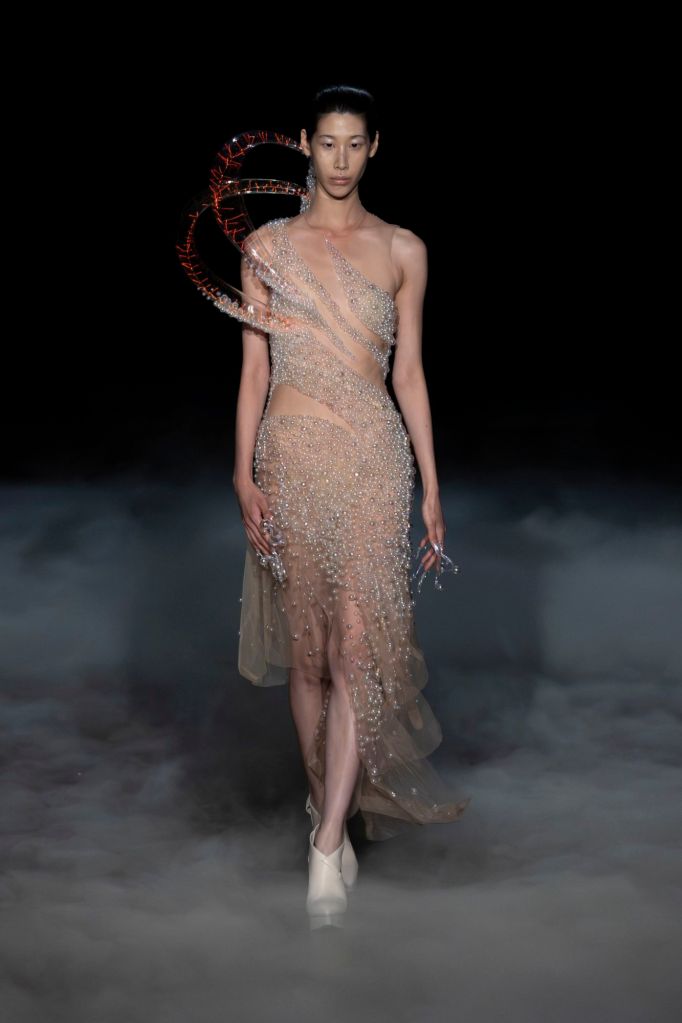
Iris Van Herpen FW26 / Fall/Winter 2026-2027, Long before scientists translated the oscillations of stars into music, the Victorian artist and inventor Margaret Watts Hughes (1842–1907) was experimenting with materializing her own voice. She invented the Eidophone, an instrument that used a membrane stretched across a receiver attached to a megaphone-shaped tube, into which she sang. Fine powders placed upon the membrane were scattered by the vibrations of her voice, arranging themselves into intricate, vibrational geometries. Separated by more than a century, Hughes’s experiments and the study of starquakes meet in van Herpen’s hands on a single intuition: that the forces moving within us are not wholly distinct from those that stir the stars. The energy of plasma, the main physical ingredient of stars, unites with the electromagnetism of the human body in Iris van Herpen’s Helix Nebula dress. Plasma has no fixed shape or volume and is the fourth state of matter. Unlike a gas, it is composed of a luminous cloud of charged particles known as ions and free electrons. The Helix Nebula comprises two sculpturally floating lunar forms of hand-blown glass infused with plasma that respond to human touch. Surrounding it are 10,000 hand-blown glass spheres that graduate in size and are seamlessly attached to illusion tulle with UV light. When the Nebula dress is worn, the body becomes a conductor of the plasma’s electrical field, altering and interacting with it. As a result, the dress momentarily incorporates the body into its electromagnetic system. The body and dress become one. Its deep nebula-red glow arises from electrons shifting between energy levels and releasing photons at precise wavelengths. Though plasma is rare on Earth, it constitutes more than 99% of the visible universe. It forms the Sun and the stars, illuminates the glowing nebulae where new stars are born, and reveals itself in the auroras that shimmer across the polar skies. With the Helix Nebula gown, plasma enters the realm of couture for the first time.
‘For years, I have been drawn to the idea of creating a garment woven from energy alone. We have shaped couture through solids, liquids, living matter and even gas. This is the first time we have worked with the fourth state of matter, plasma. Glass and tulle still hold it to the earth, but we are one step closer to couture that exists as atmosphere alone.’ – Iris van Herpen
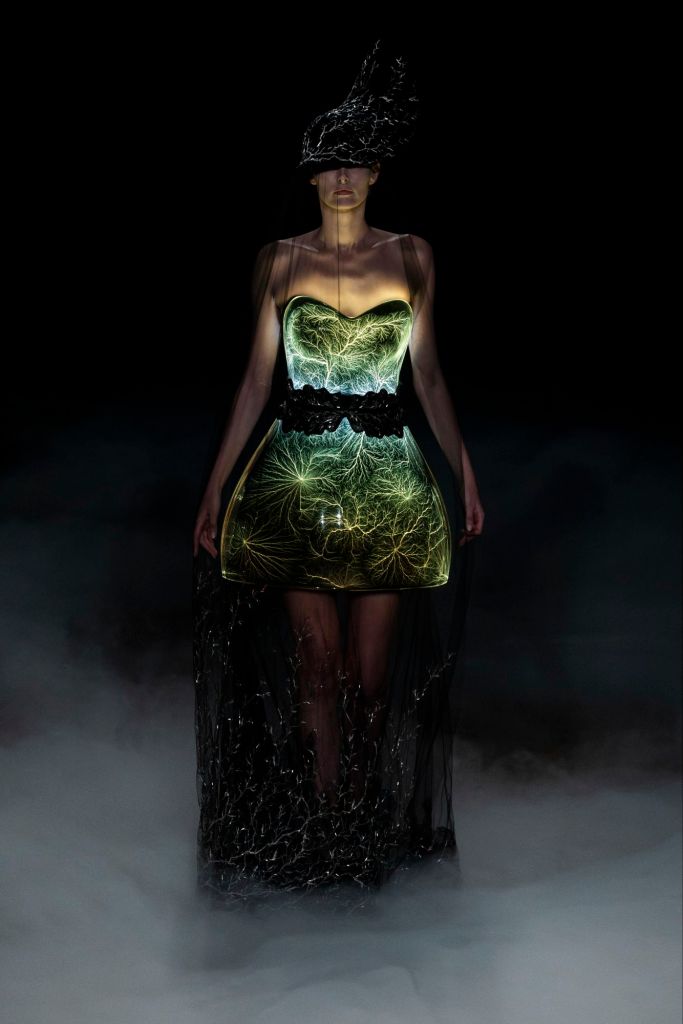
A Fractal Universe. The centerpiece of van Herpen’s new collection is the Fractal Universe look that explores the thresholds between body and atmosphere, matter and energy. Days before the show, the dress was charged inside a particle accelerator and cryogenically preserved. This transformed the dress into a metastable reservoir of energy, containing billions of trapped electrons that generate an intense electric field held within its structure.
The original intent was for the model to discharge the dress on Iris Van Herpen Haute Couture FW26 / Fall/Winter 2026-2027 runway, allowing branching flashes of lightning to complete the final act of its creation. Instead, in the nights leading up to the show, the garment began to complete the final act on its own accord. Fractal constellations of light spread across its surface as the lightning vaporized and etched microscopic hollow channels through its three-dimensional structure at a substantial fraction of the speed of light. What initially seemed like a deviation from the plan became the collection’s most profound embodiment. By escaping human control, the charged electrons within the garment determined its final expression, completing the creation through an invisible, universal force.
The final gesture of its creation belonged not to the hand of the maker, but to an elemental force woven into the fabric of the cosmos itself. These brilliant channels of light that autonomously finished the dress are temporary columns of plasma – the same state of matter found in lightning, stars, nebulae, the solar wind, and much of the visible universe.
‘Around us, and within us, vast dimensions of reality remain undiscovered. From lightning to the charged environments of particle accelerators, this collection gives form to forces that rarely reveal themselves. I do not seek to explain them; instead, they heighten our awareness of the unknown, reminding us of the mysteries that lie within this multiverse.’ Iris van Herpen
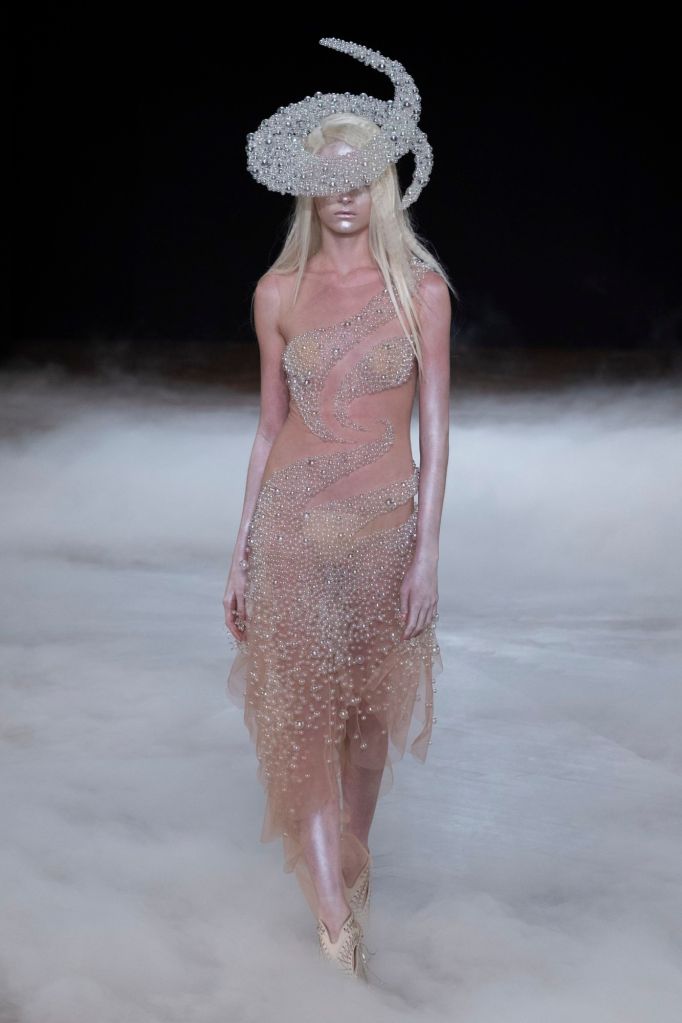
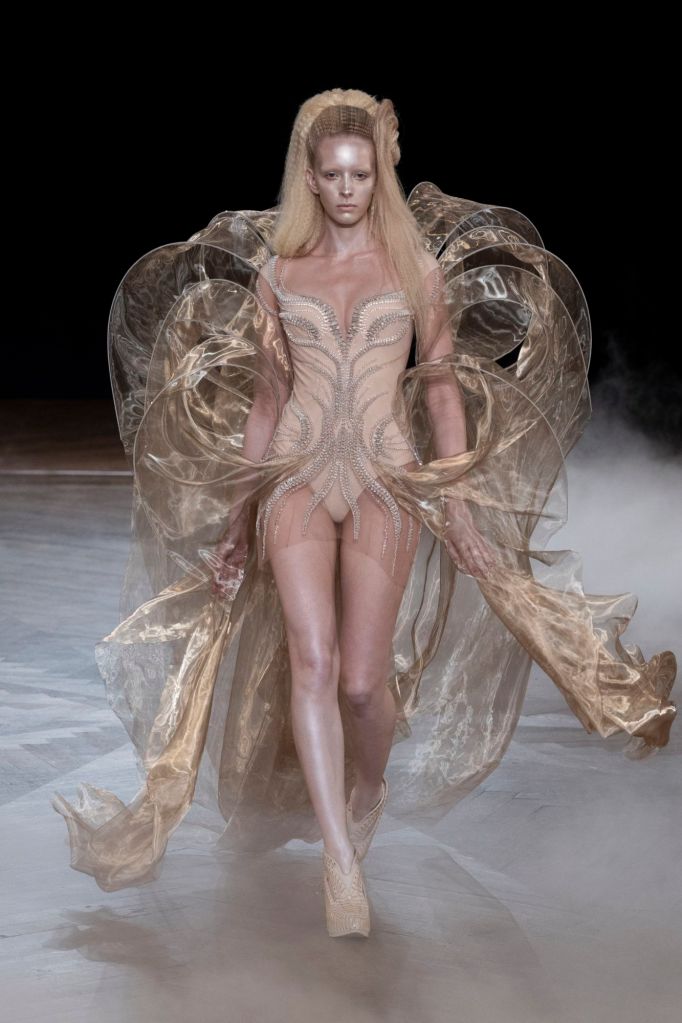
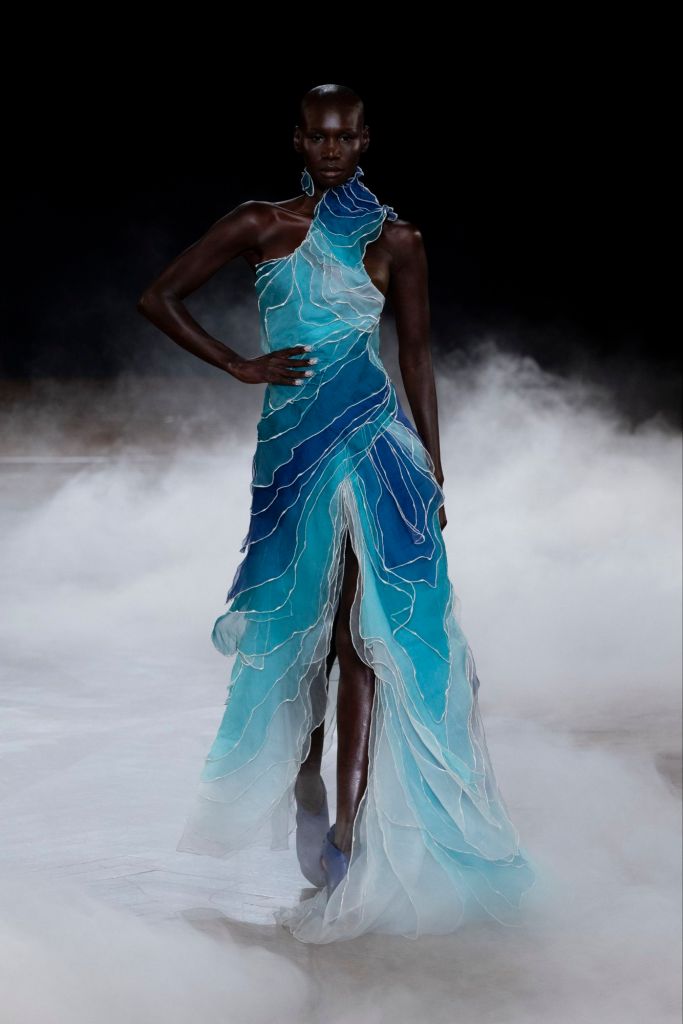
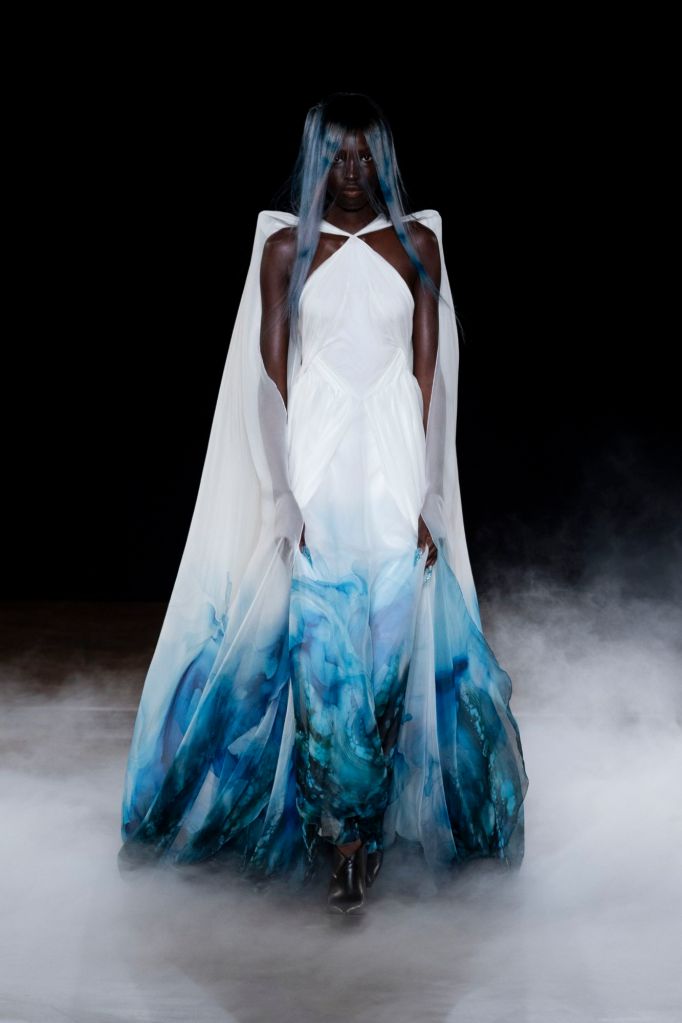
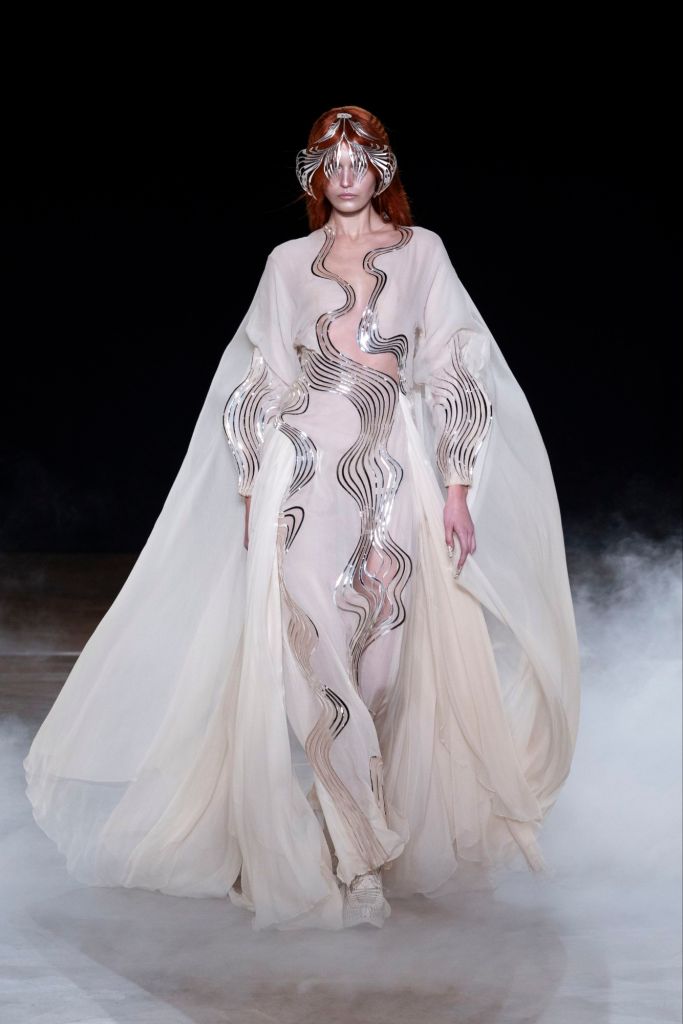
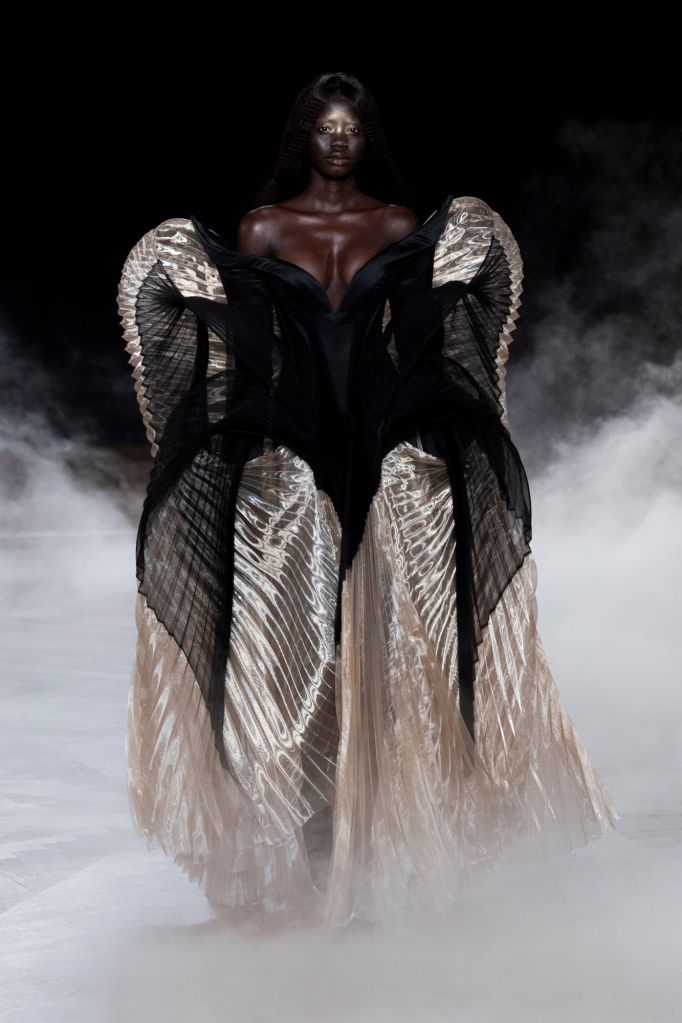
Across Iris Van Herpen Haute Couture FW26 / Fall/Winter 2026-2027 collection, silhouettes resist fixation. Velvets are laser cut into undulating motifs that bisect the body vertically, their contours continuing across the skin in delicate hand embroidery to create a subtle trompe l’œil effect. More than 30,000 gradient-sized iridescent glass spheres are used which have been individually hand-blown, floating upon illusion tulle and dissolving the body’s contours into suspended particles of light. Flowy chiffons and organzas are hand-pleated into sweeping half-wheels and suspended within moon-curved bonings of laser-cut carbon fibre, allowing the drapery to drift like invisible energy fields. Fine changeant embroideries draw electromagnetic and eidophonic traces directly onto the bare skin, placing the wearer within a field of vibration. The palette traverses the hues of the night sky, moving from midnight black and sapphire through cobalt and moonstone green to nebula red and storm-lit silver. The inspiration of the formation of stars – from plasma to nebula – illuminates this collection in which light becomes an active material, continually reshaping the deep and translucent colours and surfaces.
Ancient cultures often sought correspondences between the human body and the cosmos. Modern science reveals similar insight: the branching network inside a neuron and the branching network of a planetary storm are not identical, but they belong to the same family of form. It reveals how the universal flow of energy shapes branching geometries across all scales, from the microscopic to the planetary, from lightning on Jupiter to river deltas on Earth, and blood vessels and neural networks within our own bodies. Iris Van Herpen Haute Couture FW26 / Fall/Winter 2026-2027, The Sonic Starquake collection therefore proposes a different image of the human body; a temporary state where multiple scales of reality intersect. The cellular and the planetary, the ancient and the yet-to-exist.

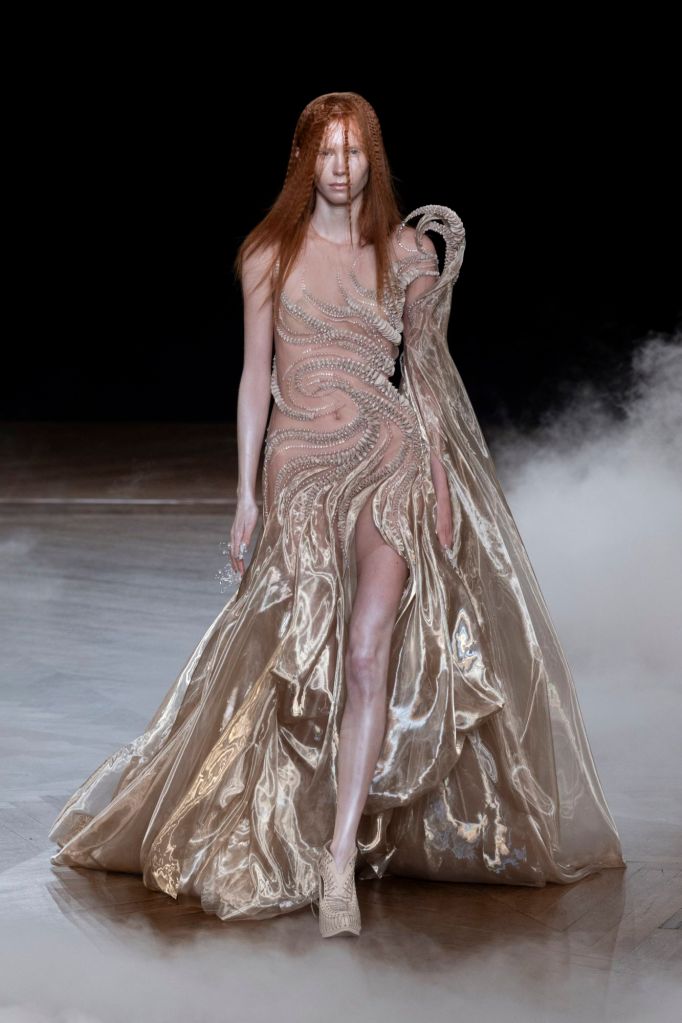
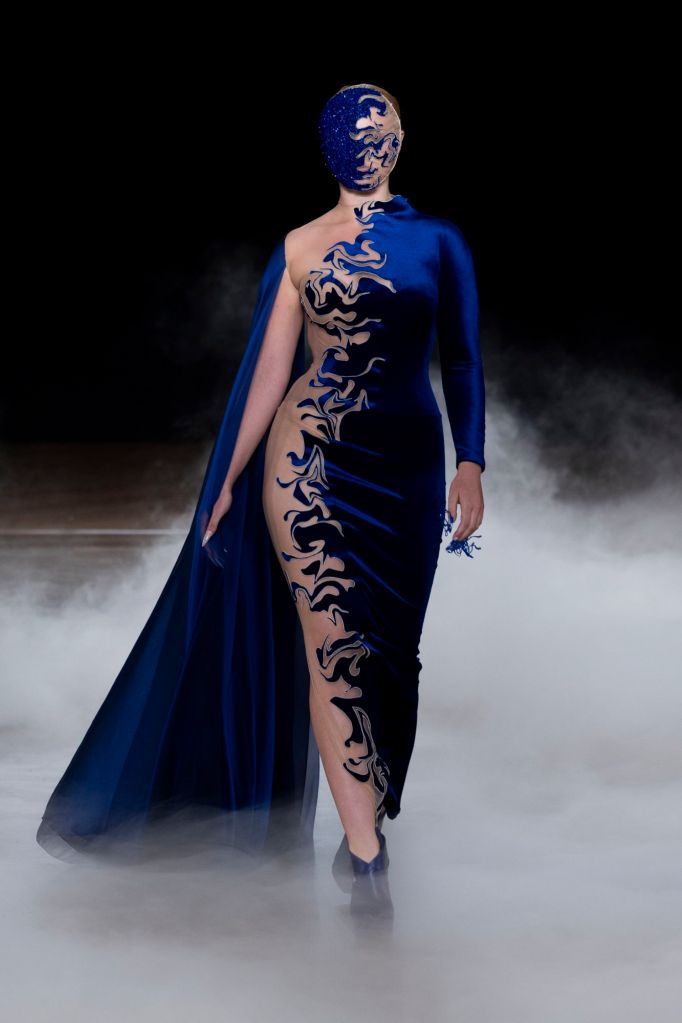
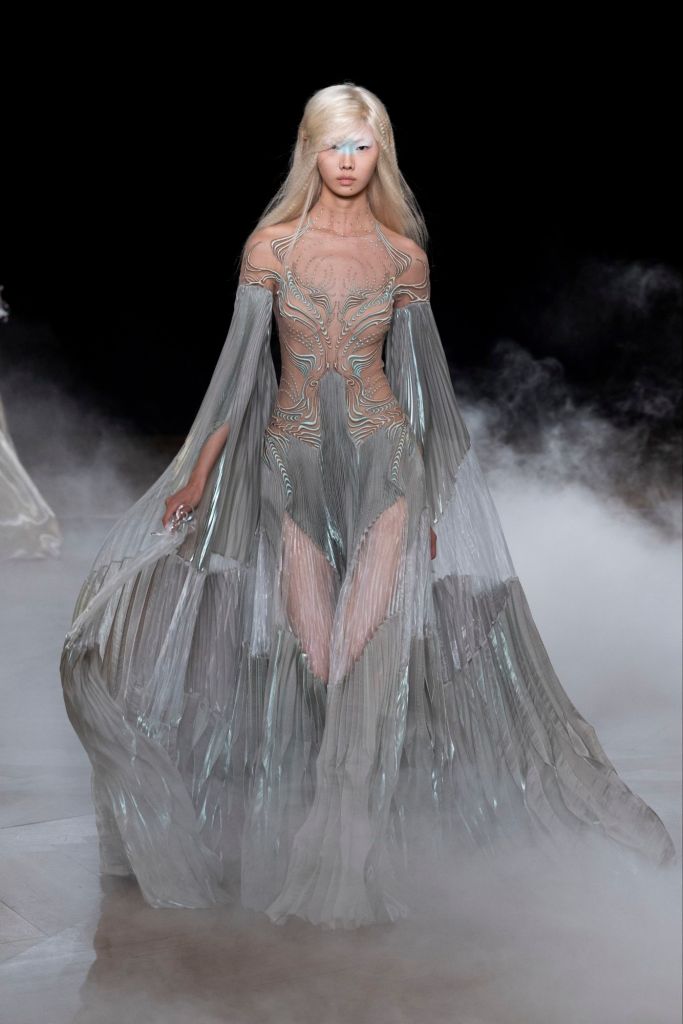

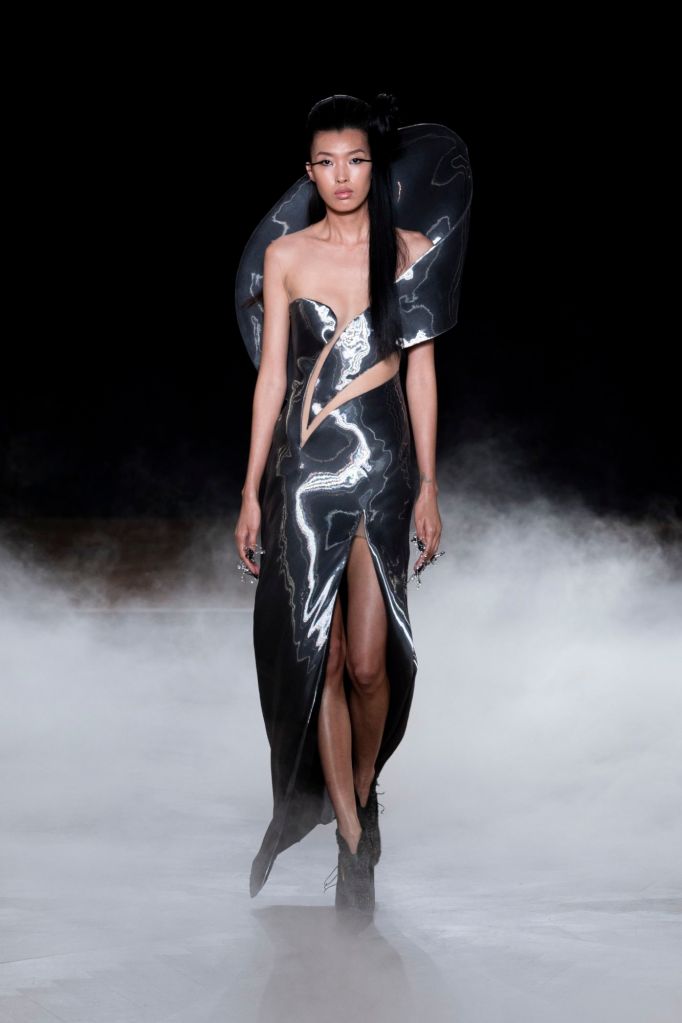




All images Iris Van Herpen FW26 / Fall/Winter 2026-2027 by the brand. PR Agency KCD World Wide.