Stem Spring/Summer 2027 / SS27 at Copenhagen Fashion Week Presents Edition 5: Re
For Spring/Summer 2027, Stem presents Re. The collection deepens Stem’s singular perspective on weaving, material development and garment construction, while opening the practice to a series of new collaborations and existing materials. Together they ask a simple question: how do we continue making while making less? Re began with a prefix. Initially, it referred quite literally to recycled materials, but gradually expanded into describing an entire methodology: rework, rebuild, repair, return, realise. As Stem approaches its fifth year, the collection reflects an ongoing reconsideration of the systems that shape fashion production, asking how existing materials, established techniques and inherited knowledge might be approached differently.
“As the brand approaches its fifth year, I found myself rethinking far more than a single collection. I’ve always questioned how Stem should operate, but this became a much larger reconsideration of how the practice itself might work. One of the biggest shifts has been asking how I can work with existing materials rather than continually producing new ones.” – Sarah Brunnhuber, founder of Stem.
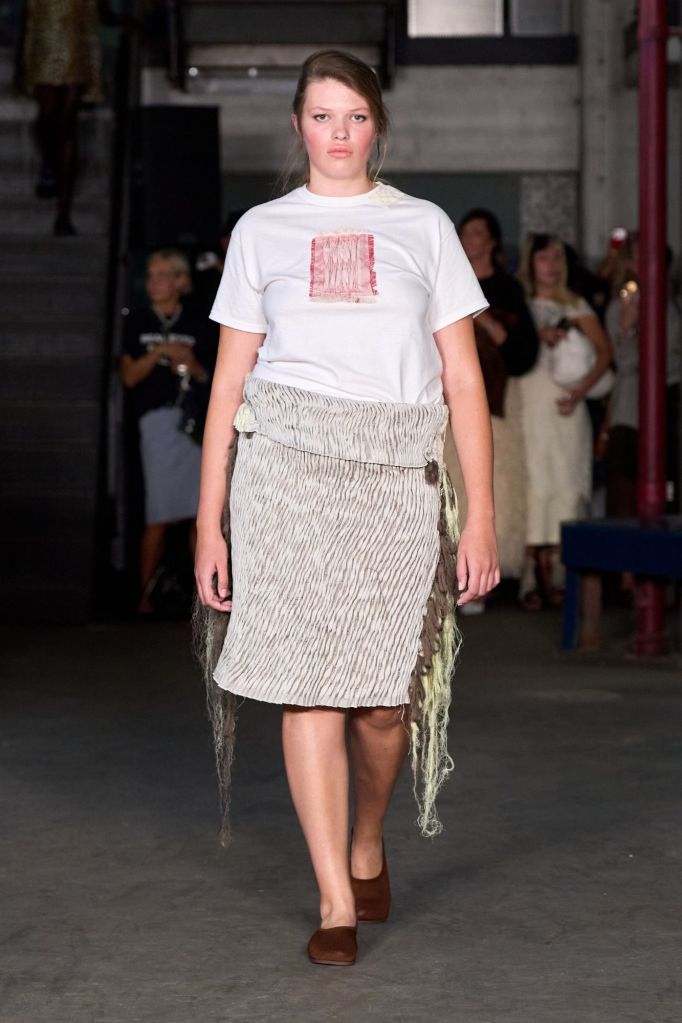
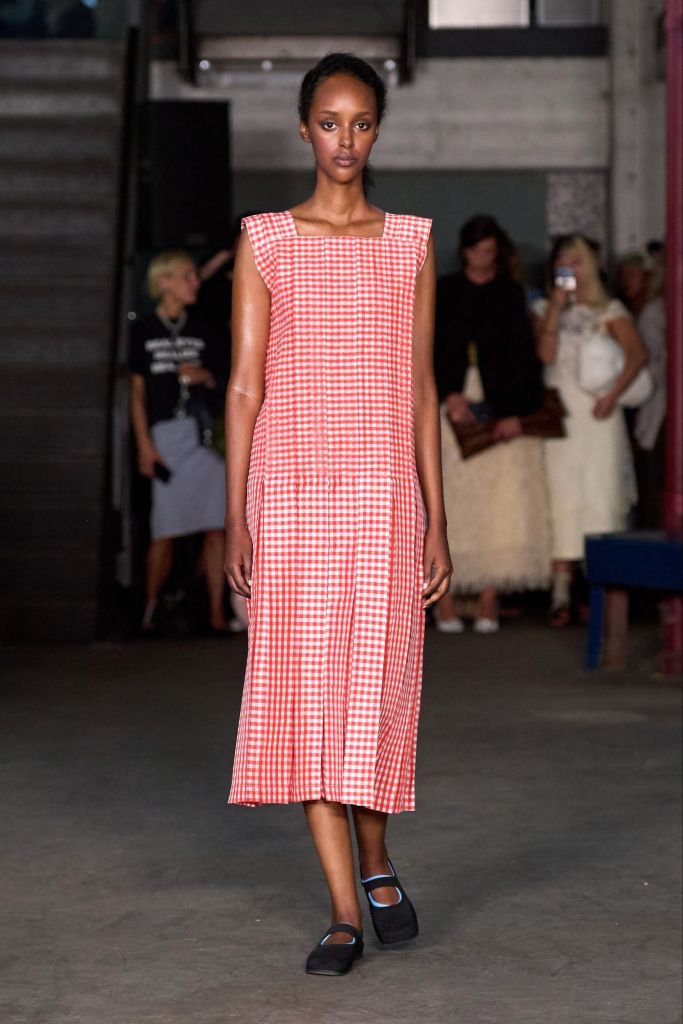
While fashion often privileges constant forward movement, Re proposes another rhythm—one that finds value in repetition, backward motion and return. Founder Sarah Brunnhuber takes her exploration of Stem’s signature pulling technique into new territory, developing woven structures that collapse naturally into pleats once tension is applied. Rather than constructing shape retrospectively, the structure already exists within the textile, allowing the garment to emerge from the logic of the weave itself.
“Those words—repetition, backward motion and withdrawal—also began to feel connected to the pleat itself. A pleat is both a forward and a backward movement, depending on how you choose to look at it. The cloth folds back into itself. It withdraws. I felt there was a relationship between the language and the technique.”
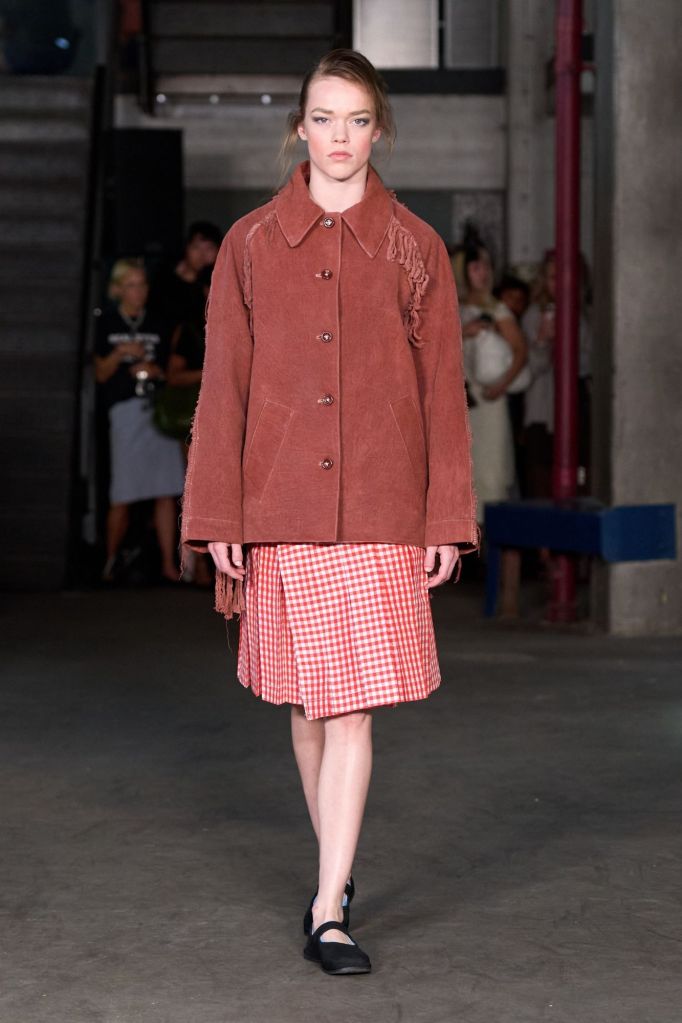
Throughout Stem SS27 / Spring/Summer 2027 collection, technical development and discovery takes precedence over novelty. Composed of eight silhouettes—many based on existing Stem forms—Re asks how a practice can continue to evolve creatively and intellectually without continually churning out something entirely new. “That wasn’t about limiting myself; it was about recognising what I actually wear, what I return to, and allowing the technical developments to become the focus rather than continually inventing new forms,” says Brunnhuber.
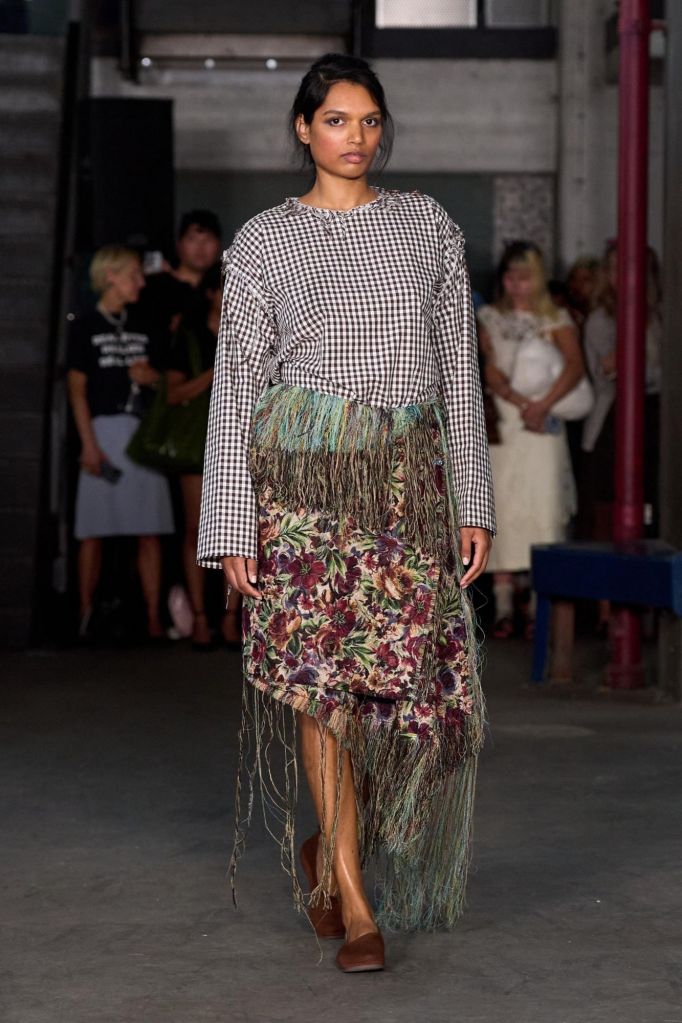
Re(ev)valuating, re(a)dressing. That question extends into a new collaboration with Ganni. Rather than beginning with a blank loom, Brunnhuber started with textiles that already existed: archived fabrics from previous collections. Responding to another brand’s material vocabulary opened an unfamiliar creative freedom, allowing Stem’s techniques to be applied to prints, colours and fibres the studio would never ordinarily produce. This season’s partnership represents a new string to Stem’s bow—a direction that the designer plans to further explore through future collaborations. “Stem has always been built around developing new fabrics. New techniques become new textiles, and those textiles become garments. But I also realised I had ideas that weren’t dependent on making new fabric. I wanted to see whether the same way of thinking could be applied to materials that were already in the world. That’s how the collaboration with Ganni began.”
For the first time, she chose to work with synthetic textiles—not as an endorsement of producing more synthetic materials, but as an exploration of how existing ones might be rethought and remain in use. Through processes of unravelling, felting, pleating and reconstruction, the showpieces remain unmistakably Stem, suggesting that the identity of the practice lies not in a particular textile but in a particular way of thinking. “Even when I begin with someone else’s fabric, the process is really about asking how it can enter the same system of making. It’s important to me that the methodology stays intact, including the fact that the garments are still made without creating cutting waste” Brunnhuber points out. By exposing the fibres themselves, the collaboration invites a more direct encounter with material, encouraging wearers to consider not only what garments look like, but what they are fundamentally made from.
Earth, Pigment and Process, A third strand of Re emerges through a collaboration with Brunnhuber’s partner, designer and founder of Pigmenta, Thomas Woltmann. Developed through a shared research project, three waxed garments—a long coat, a short coat and a bag—explore a cross-section of woven textiles, earth pigments and natural weatherproofing. Woltmann’s Danish ochre pigments are applied by hand before the finished garments are waxed with beeswax. The resulting palette is an accumulation of material decisions, each one leaving its trace. Like the rest of the collection, these pieces ask how existing resources, overlooked materials and inherited techniques might be reconsidered—not simply as environmental strategies, but as creative ones.
Repair as Participation, Presented within a former factory and waste sorting centre, Re continues Stem’s ongoing exploration of production as something visible, participatory and open. Following the workshop format of previous presentations, guests are invited to bring a T-shirt from their own wardrobe to be repaired with one of a series of woven Stem patches, also part of the SS27 collection. Each one contains the essence of an idea, small enough to be applied to an existing garment, yet capable of changing how that garment is seen, worn and valued.
“What interests me isn’t repair as a moral obligation. It’s repair as another way of continuing a relationship with clothing. A patch might restore something that’s damaged, but it can also completely change how a garment feels. It might make you want to wear something again that had quietly disappeared to the back of your wardrobe. That feels much more interesting to me than simply replacing it,” says Brunnhuber.
Rather than separating process from presentation, the installation brings material research, making and repair into the same space, allowing the fundamental ideas behind the collection to remain as present as the garments themselves. Stem SS27 / Spring/Summer 2027 with special thanks to GANNI, Camper, Pandora, CPHFW New Talent, Swedish Stockings, Louis Poulsen, Skovtex, Goldwell Nordic and Couleurs de Noir for their generous support and collaboration. The collection is presented with Camper’s modular footwear system, whose interchangeable soles and uppers offer another way of thinking about longevity. Like Re, it asks how existing objects can continue to have a life through adaptation rather than replacement. Camper is a family-run, design-led footwear brand based in Mallorca, creating original and unconventional concepts since 1975.
About Stem, Founded by designer Sarah Brunnhuber, Stem is a Copenhagen-based clothing brand and textile system, built on an innovative zero-waste methodology that eliminates cutting waste and makes the production process legible through the garment itself. Every Stem piece is constructed from certified natural fibres and shaped through a weaving technique that embeds the pattern directly into the fabric. Stem’s name—derived from “system”—reflects both its critique of an extractive industry and its proposal for a new way forward. Central to Stem’s ethos are transparency, collaboration, slowness, and the fundamental belief that fabric holds memory, structure, and meaning. Through each edition, Stem offers not only garments, but an invitation: to touch, to understand, to rethink.



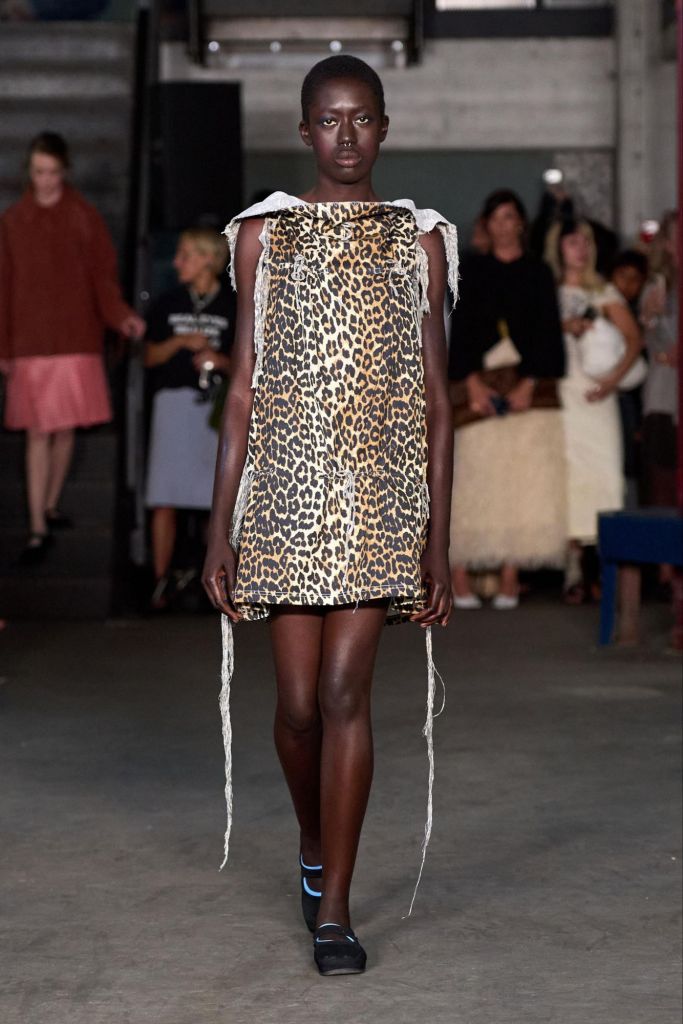


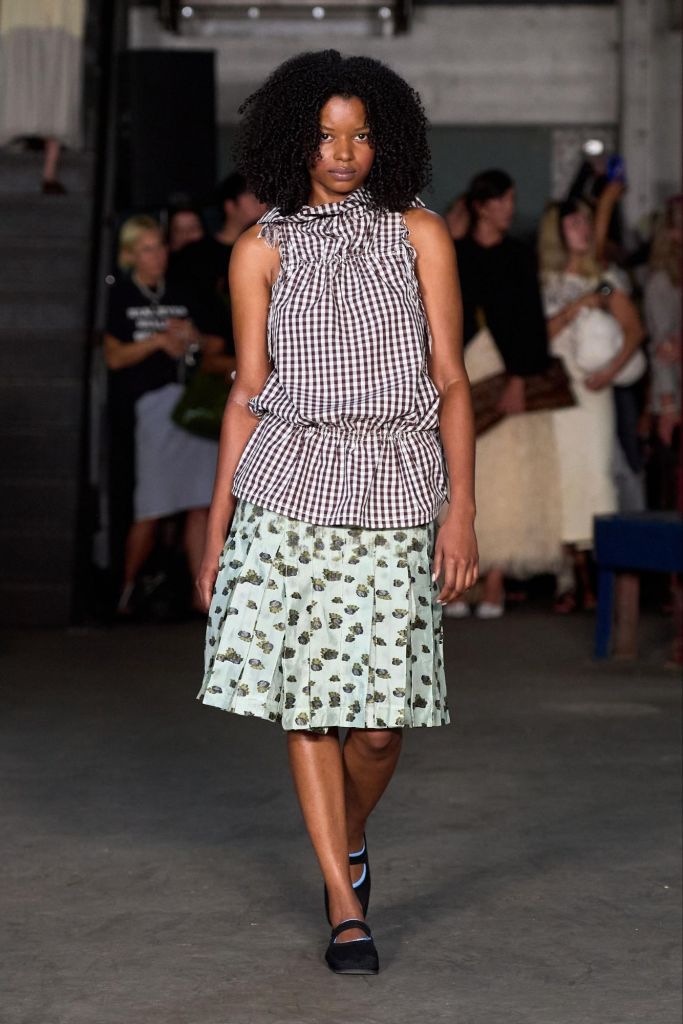

All images Stem SS27 / Spring/Summer 2027 by Copenhagen Fashion Week.